
A dental impression is a necessary procedure. It copies the patient’s mouth to create dental restorations or other dental devices. All teeth and tissue structures must be captured to ensure the model looks like reality.
However, traditional impression methods and materials can be uncomfortable for patients. This makes the procedure harder and leads to poor results. This can impact the occlusal surface accuracy, fit, and overall outcome of dental treatments.
Intraoral scanners (IOS) offer a new way to take digital impressions. Someone uses these impressions to make models.
Unlike traditional methods, IOSs perform digital scans. These can be partial or full-arch scans, including the front, molar, and palatal areas.
The team combines the scans to create a 3D image. People use this image to make a model.
The trueness and accuracy of IOSs are prerequisites for fabricating quality dental restorations. Both metrics have been studied in lab tests. However, little has been done to compare these devices’ accuracy, trueness, and overall performance.
This evaluation aims to determine which scanner provides the most accurate digital images. We will also examine how different intraoral scanners work in controlled, extraoral conditions. We will use standard models and proven measurement methods to complete this.
Why Accuracy Matters in Intraoral Scanning
Before we compare intraoral digital scanners’ performance, it’s essential to discuss their accuracy. Accuracy in IOS devices has two parts: trueness and precision. Trueness is how close the scan is to the actual anatomy of the patient. Precision is how consistent the scan results are when scanning the same object several times.
This is very important. Some scanners can be precise but not accurate. This can cause repeated errors and lower accuracy. Since accuracy directly influences dental treatments’ success, longevity, and comfort, even the smallest inaccuracies and discrepancies can result in significant clinical consequences.
Dentures, abutments, veneers, and onlays must fit the tooth surface exactly. Otherwise, there’s a risk of recurrent decay, chipping, restoration failure, or a higher need for readjustments and failure.
Implants do not have a periodontal ligament. This means they cannot handle any misfit. A misfit can cause fractures, bone loss, or long-term implant failure.
In orthodontics, it is essential to model the upper and lower jaws accurately. Even small mistakes can affect treatment results. Ultimately, scanning accuracy is key for reliable results in almost any dental procedure using intraoral digital scanners.

Overview of Intraoral Scanners in This Study
Digital intraoral scanners are evaluated by their accuracy, including trueness and precision. Here is a summary of reviews, studies, manufacturer data, and tests done on four high-end scanners:
- 3Shape TRIOS 5
- CEREC Primescan
- Planmeca Emerald S
- Medit i700
This overview examines the accuracy of individual models and their comparisons. It also highlights other important performance insights, such as speed, usefulness, scanning methods, and software connections.
1. 3Shape TRIOS 5 ($14,999.00)
The 3Shape TRIOS product line has always provided great accuracy, and 3Shape TRIOS 5 is just as good. In a study done in 2024, TRIOS 5 had the best accuracy of all the devices tested. It showed about 54.9 µm trueness and 37.8 µm precision.
Another study found that TRIOS 5 had the smallest error, with an average error of about 112 µm. This performance is similar to that of the previous TRIOS device, the TRIOS 4.
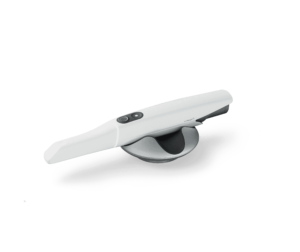
TRIOS 5 has necessary design improvements in performance and features. The wireless handpiece is now more ergonomic, making it easier to handle. Feature-wise, the device relies on proprietary scanning software that uses AI to combine scan data and remove artifacts.
The scanning speed and user experience are great. The device provides fast and reliable scans with few errors. Other studies show the TRIOS 5 oral scanner offers unmatched accuracy and consistency.
2. CEREC Primescan ($10,999.00)
Dentsply Sirona’s Cerec Primescan is a well-known intraoral scanner. It is famous for its high accuracy, especially for single-tooth and quadrant scans. A study from the University of Zurich found that Primescan accurately captures a full arch scan. It has a low deviation of just 33.8 µm.
However, results varied in different in-vitro and in-vivo studies. Other results were clinically acceptable but ranked lower than Primescan’s competitors. Primescan showed about 72 µm trueness and around 49 µm precision. This indicates a higher error compared to the TRIOS 5 model.

The study above found that Primescan had the highest average deviation of 127 µm among the tested scanners. Still, despite the mixed results, all errors were within the clinically acceptable limits for dentistry applications.
Primescan is exceptionally fast and can capture up to 1 million data points per second. The designers made the device a bit heavier than the competitors and built it with ergonomics in mind. It’s a suitable device for applications with a fast turnaround time.
3. Planmeca Emerald S ($11,999.00)
Recent studies ranked the Planmeca Emerald S as one of the best for speed and accuracy. Its average deviation is about 117 µm, which is close to TRIOS 5’s 112 µm.

Emerald S has a trueness measure of 50-53 µm, which is within clinical requirements and makes it a top performer. Planmeca’s scanning technology enables short scanning times, and the same implementation occurs with Emerald S.
The device is fast and easy to use. Its lightweight design and compact tip help it heat quickly to prevent fogging. It provides a great balance of fast scanning speed and dependable accuracy, making it ideal for clinical routines.
4. Medit i700 ($9,999.00)
The Medit i700 is uniquely positioned between accuracy and affordability. Its accuracy matches that of more expensive models. Studies of full-arch implant scans show about 60.5 µm trueness and around 40.6 µm precision. This performance is better than Primescan under the same conditions.
The Medit i700’s average error is about 114 µm, just a bit behind the TRIOS 5. This shows that the device is a high-accuracy scanner.
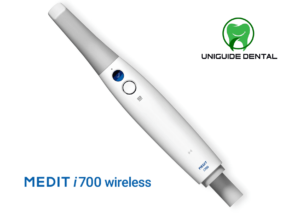
The manufacturer claims their product can achieve an accuracy of about 11 µm in perfect conditions. However, clinical trials were less ideal, leading to a higher error.
Still, as mentioned earlier, Medit i700 delivers on accuracy, which places it near TRIOS 5. The device is easy to use.
One of the lightest scanners for taking digital impressions is available. It has great intraoral digital technology and excellent software integrations. It is a great choice for clinicians looking for a combination of accuracy and cost-effective workflow.
Methodology: How the Comparison Was Conducted
This comparative analysis was conducted as an in-vitro study to ensure the control and reproducibility of testing conditions. The team created a standard full-arch reference model. Researchers used this model for scanning and made it with high-precision 3D printing.
Each scanner in this study analyzed five full-arch scans of the dental model. This helps assess the trueness and accuracy of digital impressions.
- Researchers measured trueness by comparing each scan to the high-resolution reference model. This showed how closely each scanner’s output matched the actual shape of the model, measured in microns (µm).
- Researchers quantified precision as the variability range across repeated scans for each intraoral digital scanner.
- Additional performance metrics include scanning speed, ease of use, and compatibility with various CAD/CAM software.

Results: Benchmarking Scanner Performance
In summary, TRIOS 5 has the best trueness and precision rate among the models. Its average deviation is about 112 µm. The Medit i700 follows with 114 µm, and the Emerald S has 117 µm. Cerec Primascan has the highest deviation, approximately 127 µm.
The average deviation is under the 200 µm error limit for full-arch models. This means all digital models are good for clinical work.
TRIOS 5 is the most accurate, with a trueness of 55 µm. The i700 follows with about 60 µm. Primescan has a trueness of around 72 µm when scanning fixed dental prostheses.
These differences are statistically significant. However, like the average deviation, all clinical study authors noted that the values were within clinical tolerances.
Primescan has high-speed scanning technology, as does Emerald S. Both TRIOS 5 and Medit i700 scan efficiently. The speed difference is small, especially as the software keeps getting better.
Ergonomics is also important since it allows for more comfortable handling and reduced hand strain. TRIOS 5 is an incredibly compact, wireless device that improves mobility. Permascan is the heaviest device in this assessment. However, it offers a wider field of view and does not need angle adjustments.

Conclusion and Final Recommendations
This assessment proves that all four intraoral scanners mentioned are highly accurate. TRIOS 5 provides great overall accuracy. Primascan is better in some detail-focused situations.
Emerald S and i700 match the top models in accuracy. They also offer advantages in speed and cost.
All these scanners perform well in dentistry. Many studies show that they create reliable digital impressions. These impressions can effectively replace traditional methods in modern digital dentistry.
To learn about intraoral scanners and scanning techniques, visit Uniguided Dental. Check out our list of the top 10 intraoral scanners.
One reply on “Benchmarking the Accuracy of Intraoral Scanners: A Performance Analysis“